

Publication
Semantic clusters that convert thanks to neuroergonomics
The profitability challenge
One of the questions that comes up frequently when studying semantic clusters (and which applies to all acquisition channels, SEA/SEO, social media…) is: « OK, this channel brings a lot of visitors to the site, but what about conversion? » (meaning: « how do I turn these visitors into prospects or directly into customers? »).
In other words, isn’t there a risk of investing time and money in a channel that ultimately might not be as profitable as expected?
Just a few weeks ago, I would have given you the same answer as most traffic acquisition specialists: » I can guarantee you the best possible cluster — it will be well designed, my writers will integrate quality content, well-structured, interesting for users, but when it comes to converting visitors into customers, I can guarantee nothing, as it depends far too much on your products, your offer, your competition…«
Fair enough. I have been an e-merchant myself since 2009 and I know that argument well.
Who could blame a professional for doing their job well and asking you to do yours, so that together you produce the best results?
And then one day, in early 2017, I decided to attend a conference by an expert in neuroscience…
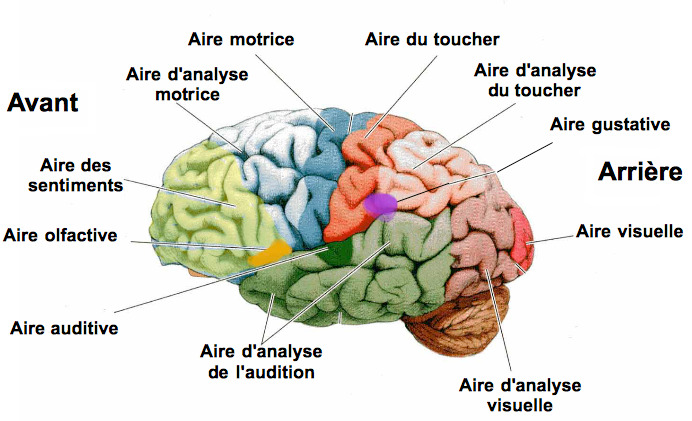
Neuroscience, neuroergonomics, and the web
Implementation and conclusion
Definitions and a hook
Wikipedia tells us:
» Neuroscience encompasses all disciplines studying the anatomy and functioning of the nervous system (brain, spinal cord, nerves, sensory organs, and autonomic nervous system) and its diseases. «
Fine, and neuroergonomics?
» Neuroergonomics is the application of neuroscience theories and tools to ergonomics. «
Thanks, we guessed as much : )
This conference was meant to show us how neuroergonomics could improve web pages: how to make a page attractive and as effective as possible.
I attended and an hour later… Illumination. Just kidding — it took me nearly two weeks, but clearly the speaker was brilliant, the topic fascinating, and the contribution of neuroergonomics obvious to our collective quest for the Holy Grail: conversion.
Speaking to our visitors’ brains
Neuroscience moves fast. Every month, we learn new things about how the brain works.
It is the famous target of every advertiser. Remember the quote from Patrick Le Lay, then CEO of TF1, who can hardly be called incompetent: « What we sell to Coca-Cola is available human brain time« .
Our brain operates on primary drives:
- I must protect myself.
- I must eat.
- I must reproduce.
- I must rest.
- I’d like to experience pleasure.
- I do everything to avoid what is unpleasant and dangerous.
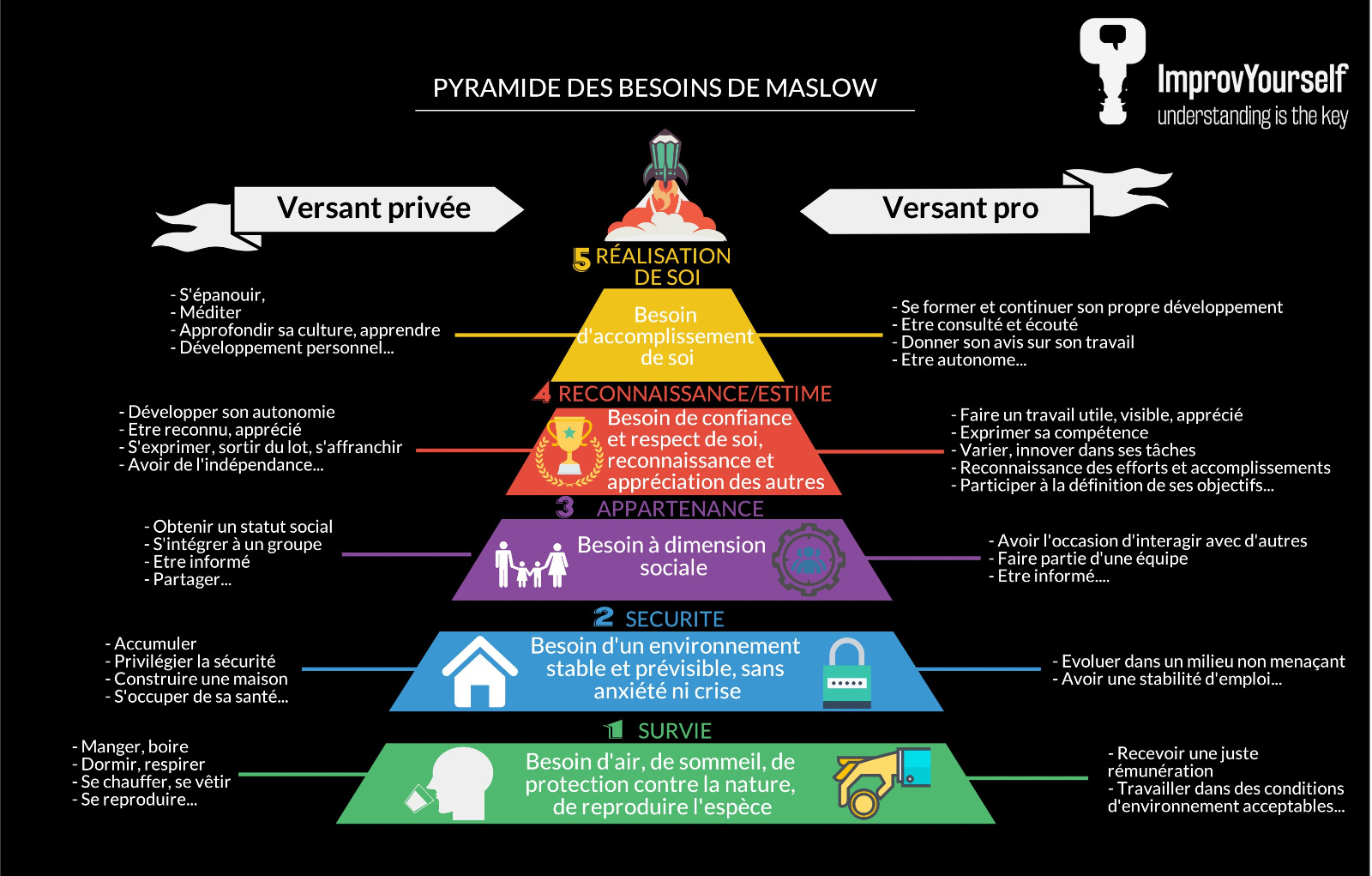
As a merchant (which we all are the moment we publish anything online), we have every interest in communicating effectively with the brains of our targets.
And to communicate well, you need to know your audience, how they work, what interests them.
You could rely on market research and buyer personas to profile them, like everyone else. Do you want to do what everyone else does?
Neuroergonomics
The goal of neuroergonomics for the web is to help us create pages that resonate with visitors, regardless of their profile (male/female, young/older, etc.).
To do this, we focus on two things:
- The brain’s information acquisition process and its endocrine response.
- The attention process.
The slide below, which was part of the conference I gave at SEO Campus Lyon in April 2017, presents these two elements:
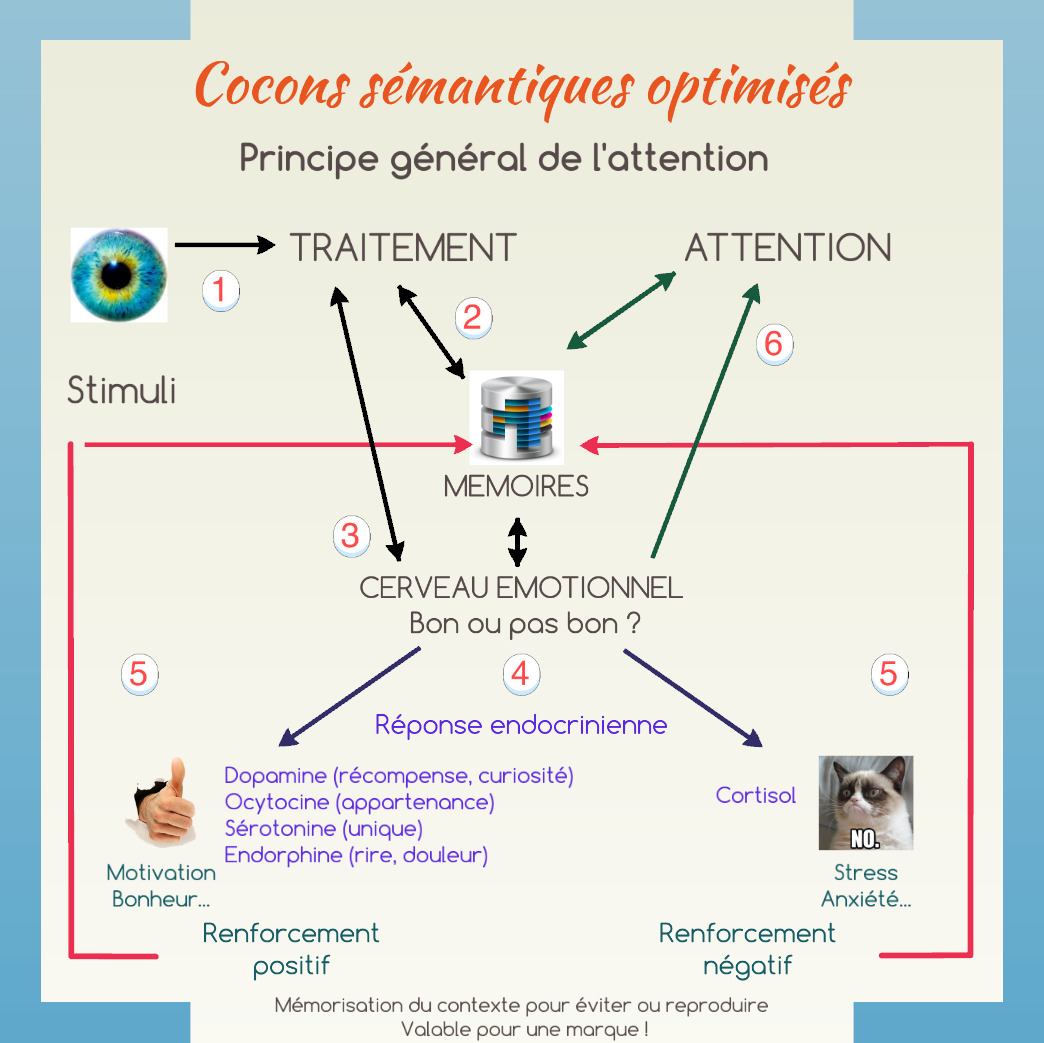
I won’t replay the entire conference here (here is the link to the slides), but here are some key takeaways:
- The brain itself is completely blind.
- It processes electrical signals from the 5 senses — in particular vision when viewing a web page.
- Cortical areas of the brain perform an analysis of what is transmitted to it (step 1 on the diagram).
- The problem is that it receives hundreds of thousands of stimuli per second, and our attention cannot focus on everything.
- That is why all sorts of processes are handled almost automatically: breathing, organ function, reflexive reactions, driving (do you think about what your feet are doing when you drive?), etc.
Under these conditions: how do you capture attention? By leveraging the rest of the process:
- The brain calls on our memories to identify what it receives (step 2).
- These memories, along with the cortical areas, then consult the emotional brain (or limbic system) to evaluate the situation (step 3).
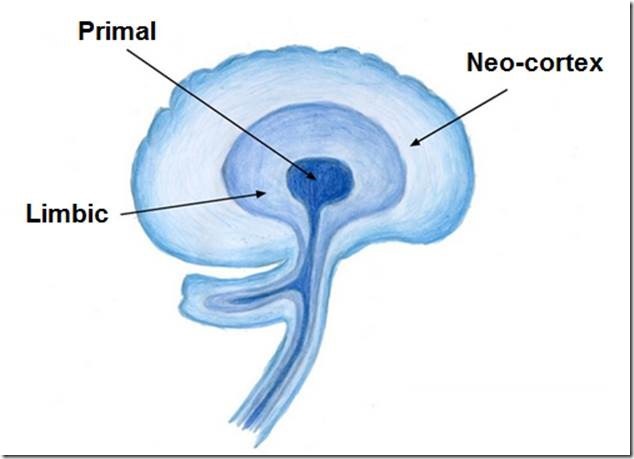
But wait — « emotional brain » — does that ring a bell? It is precisely through EMOTIONS that we are supposed to persuade people, isn’t it? Every conference, article, video, and book tells us that what we publish will only hit home if it generates an EMOTION. Let’s continue:
- The emotional brain answers the question: is what I am receiving good or bad for me (to protect, to nourish, etc.)?
- It simply responds YES or NO, which inevitably triggers an endocrine response (step 4).
- Skipping the details on the 60+ neurotransmitters involved, here are the most important ones:
- If it is not good for me: we produce cortisol, and we hate it.
- If it is good for me, it will be dopamine, oxytocin, serotonin and/or endorphin, and we love it.
- The more a stimulus is considered important, the stronger the endocrine response.
What follows is clear (step 5):
- What we hate brings feelings of stress, anxiety, etc. We do not want to repeat it => negative reinforcement.
- What we love brings feelings of happiness, motivation, etc. We want to repeat it => positive reinforcement (as with dog training).
To sell, a brand therefore has every interest in being perceived positively.
Especially since what is considered harmful to oneself is imprinted much more strongly than what is good: the brain is designed to ensure our survival. If you have experienced trauma, it is imprinted for life — even if it lasted only a few seconds, long ago…
The quest for attention (step 6)
OK, but how do we capture our visitor’s attention?
Attention is rare and precious. Out of 100 visitors to an e-commerce site, only 1 on average will buy — that is 99% lost…
Here is a summary of how to handle it:
- Use the old concept taught in the military: the SMESC framework:
- Shape — Have a beautiful design, polished visuals.
- Shadow — Highlight what needs highlighting with shading (hmm, that may not align with current trends — but anyway…).
- Movement — Attract the eye with an animation.
- Gleam — Same with a flash of light.
- Color — Play with color contrasts.
- Sound — Getting tricky, but why not in certain cases.
- Smell — Let’s revisit this in 10 years : )
- Trace — Out of context.
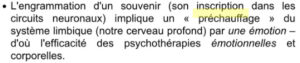
- Take advantage of neural priming (I can feel your attention rising…). It has been demonstrated that a person whose specific brain area has been previously warmed (physically) reacts faster and better to certain stimuli. Consequently, using certain visuals or phrases will prime the brain for what follows — leading it to… CLICK OUR CALL TO ACTION. Hallelujah!
- Account for emotional valence: when an element of our web page triggers a known (and ideally positive) memory, attention is reinforced.
- Above all, pay attention to attentional habits: if an element is out of place, a critical process kicks in — and the user leaves. A logo is usually at the top left, so don’t put it on the right.
- But the most important thing of all: don’t trigger critical thinking. The voice in the back of the head that says: « it’s full of typos, can’t be serious — that price is too low, where’s the catch? — nothing is happening here, I’m leaving. » This involves practices such as:
- Marking the path.
- Staying simple.
- Staying consistent.
- Offering exit doors — but ones that are less attractive than continuing…
- And a few others…
At the end of his talk, the speaker showed us 3 case studies: sites that had applied his principles and were clearly well-designed, beautiful, effective…
I have little doubt about the effectiveness of neuroergonomics — but you might.
I therefore decided to take two actions:
- 1. Implement neuroergonomics in my future clusters.
- 2. Carry out « before/after » tests on high-traffic pages to measure the impact on conversion rate.
I will report back on both of these in separate articles.
[April 2017] For the record, the first action was successfully completed — the second is ongoing.
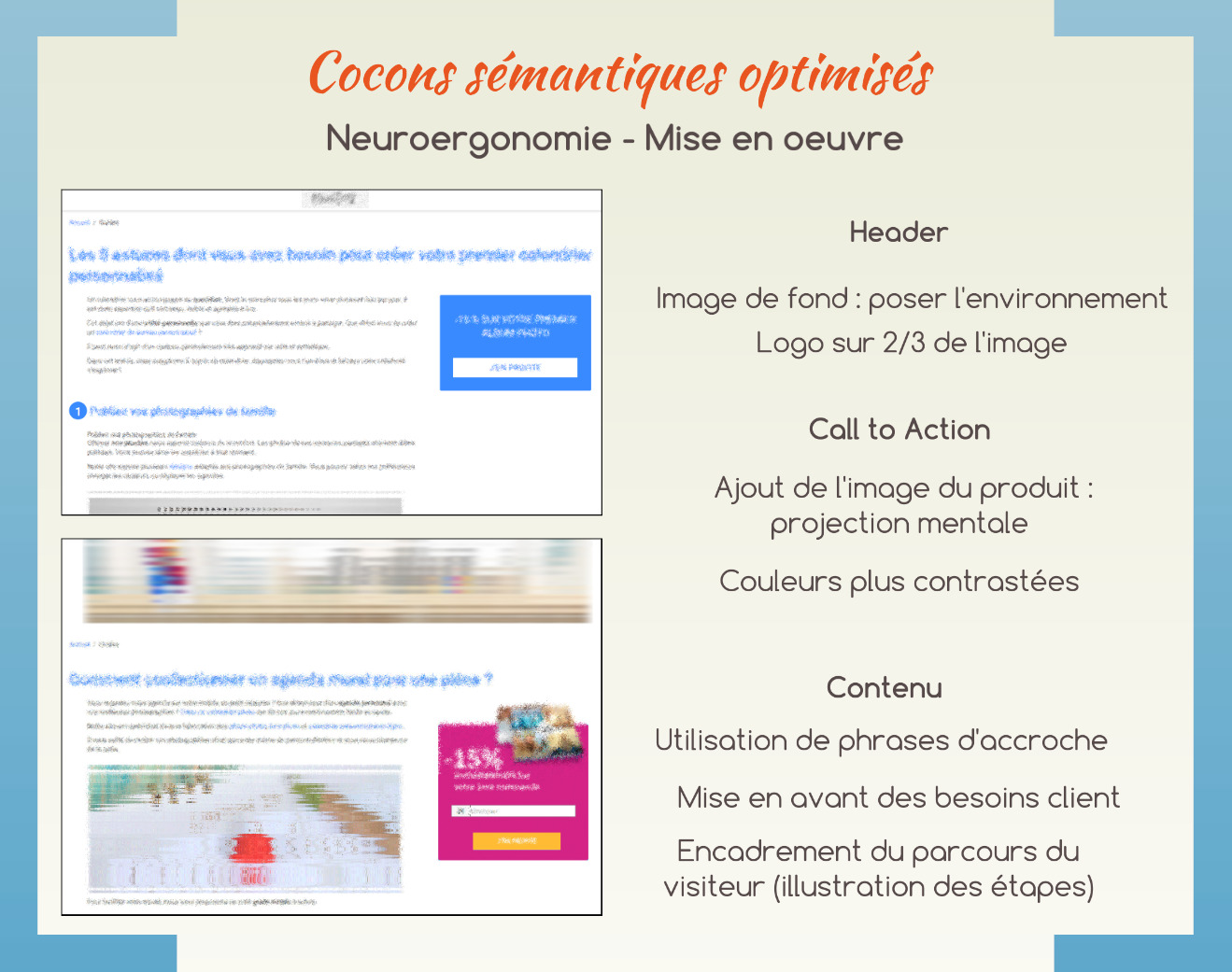
As a teaser, here is a slide summarizing point 1, showing the same page before (top) / after (bottom):
These two actions represent for me the best possible conclusion: theory followed by practice. I will be fully transparent about the results obtained, because my reputation as a consultant depends on it.
In the meantime, I am open to any discussion on the topic.
Interested in semantic clusters built for conversion? See our semantic cluster SEO service and our Google Discover strategy — two engines that bring qualified, converting traffic.
[hc_faq] Q: What is « speaking to our visitors’ brains »? A: Neuroscience moves fast. Every month, we learn new things about how the brain works. It is the famous target of every advertiser. Q: What is the quest for attention (step 6)? A: How do we capture our visitor’s attention? Attention is rare and precious. Out of 100 visitors to an e-commerce site, only 1 on average will buy. [/hc_faq]