

Publication
the 6 steps to manage your own press relations on a tight budget
One of the best ways to get your brand or service offering known is to get the press talking about it.
A press article can notably:
- Reach a wide audience.
- Imprint your brand in people’s minds.
- Open new partnership opportunities.
If the media outlet covering you is a website, the article will include a very high-quality link back to yours, thereby strengthening its authority with search engines and, in turn, your visibility.
In short, a press article, like any well-executed communication act, brings visibility and leads that will sometimes convert into clients and therefore into revenue.
A real-world case: CatSonics press relations
March 2015: I stumble upon a series of articles on the web explaining that American scientists demonstrated how to create music adapted to cats’ ears.
Noticing that nobody had entered this space yet, and after studying its potential, I quickly decide to found CatSonics – Music for Cats, with the aim of bringing a wellness service to cats left alone in apartments or in stressful situations (transport, vet visits, cat shows, temporary care by a stranger, etc.).
After months of research, work and testing with industry professionals, the music offering is in place.
The problem: nobody knows about this entirely new offering, and we do not have the capacity to build a community around this project to which we are not devoting ourselves full-time.
France is not the primary target, but it is still interesting to test our offering in our mother tongue before going international, which is never straightforward.
On top of that, we have never done press relations before.
To cap it all, we have virtually no communications budget at this stage.
In any case, it seems wise to understand the lay of the land before embarking on any approach, so I decide to educate myself as much as possible on the subject and study the options available to us.
1. Option 1 – Hiring a PR professional
Unsurprisingly, going through a professional allows things to be done properly, as they will know how to:
- Carry out a complete assessment of the offering and its potential.
- Propose an appropriate action plan.
- Identify which journalists to contact by leveraging their network.
- Write high-quality Press Releases and Press Kits.
- Manage follow-up over time.
Everything needed to succeed in a Press Relations campaign. Or not.
1.1. Finding PR professionals
Having only a vague idea of the rates charged by agencies or freelancers in the field, I decide to consult a representative panel — except that I don’t know a single one.
Like everyone, I have a few connections in my network or on social media who could give me some contacts, but this time I prefer to go it alone, especially since I have an idea in mind.
In the course of my work as an SEO consultant, I had occasion to use a very powerful tool: Scrapebox.
Used by some to spam the web with thousands of automatically posted links (a practice obviously forbidden and now quickly penalised by Google), this toolbox also allows for very comprehensive web searches and automatic collection of contact emails.
I launch the tool and run searches around the keyword « press relations ». Within minutes, I have a list of over 800 URLs of websites related to the subject in one way or another. I filter the results in Excel and run a second search on the remaining URLs, this time with the goal of retrieving the contact email of each site.
I end up with a few hundred emails that need to be verified and deduplicated to avoid emailing multiple people from the same site.
In the end, within 2 hours I have 51 emails of agencies and freelancers. Not bad at all when you know absolutely nobody in the field.
1.2. Writing and sending the email to PR professionals
My objective at this stage is to obtain proposals and quotes, allowing me to understand:
- How PR professionals perceive our offering, which is quite unusual.
- What actions they propose.
- What their rates are.
- How quickly they plan to act and the proposed timeline.
All of this so I can make an informed decision: can we or can we not take the risk of investing in a high-potential but likely expensive channel?
The email I send them must deliver results. After all, none of them know me and many consider our offering far-fetched (though it turned out that a competitor had launched and raised over $250,000 from the public for a near-identical project — something we didn’t know at the time).
One of the first best practices when emailing someone who doesn’t know you is to keep it short and to the point, without frills.
I therefore opt for a direct and concise style, yet complete: I want my contact to understand in a few sentences who I am, why I am reaching out, the context, and what I expect from them.
To be taken seriously and avoid template responses, I decide to add a line at the end of the email asking for a personalised reply.
Here is the email in question:
—————-
Hello,
I am writing to share the presentation of the first French music offering dedicated to cats.
You can discover the presentation in the attachment. Perhaps you’d like to learn more about this unique project that is close to our hearts!
I am at your complete disposal to answer any questions you might have.
Kind regards,
Stéphane Jambu
—————-
In the week that follows I receive around ten responses by phone or email, including these excerpts:
- « Please know that we are perfectly equipped to meet your request for PR support, both for the journalist and blogger audiences.
We develop strategies at the local, regional and national level. My dual background in linguistics and communications also ensures solid follow-up on English-language files for your international activities. » - « Thank you for your email. I wanted to test it on my cat before replying — see the video attached — and Leo seems intrigued and relaxed. This original idea piqued my interest, so happy to talk whenever suits you… »
- « I have noted your request and thank you for getting in touch. Like you, I prefer a first chat via Skype to gather the details of your needs and expectations. My fees naturally depend on the PR budget you wish to allocate. With a budget of between €500 and €900 per month, excellent PR work can be done to launch a brand. »
It is time to move to the next step: talking directly to understand whether their proposal matches our needs and capabilities.
1.3. Contacting them and obtaining proposals
In the days that follow, I speak with around ten PR professionals.
They present their company and their work, share their thoughts on our offering and how they envision a potential collaboration.
Some are clearly too « big » for us: they work with established brands or those with a substantial budget.
One of the freelancers had already done promotion for dog beer, which tells you something…
In the end, I have 7 proposals, including these examples:
- A freelancer proposes, for a minimum budget of €2K, to launch a campaign with a demo CD:
- Writing the press release.
- Using her journalist database, targeting around thirty contacts.
- Target: women’s press and general public media with cats or a dedicated pets section.
- My team shipping a CD to each contact with a personalised note and dedicated email.
- Journalist follow-up.
- A 12-person agency proposes:
- Targeting women’s press (new concept/service section), pet media, certain TV programmes.
- Going international afterwards.
- The rate is a minimum of €1.5K per month with a minimum 6-month commitment — ouch.
- A mid-sized agency sends a very detailed proposal with a 3-month action plan:
- Organising a Press Tour with interviews by targeted journalists.
- Setting up recurring communications around our news, in-depth articles, etc.
- Action tracking and monthly reports.
- All for €1.5K per month, of which €500 is performance-based => interesting!
My initial objectives have been met: in just a few days I know what is involved, what can be done, how quickly, and at what cost.
Except that I can clearly see we are not completely ready: we do not have the promotional tool par excellence (a CD), no team member wants to step forward for interviews, and the financial risk remains high. We know that in France, most people prefer to pirate music, unlike in Anglo-Saxon countries for example.
On top of that, we are inexperienced in PR and risk being taken for a ride by our provider.
I therefore decide to dig deeper on my own and attempt some targeted actions.
2. Option 2 – Doing your own PR
2.1. Being realistic and preparing your strategy
At this point, let’s be honest: I know full well that substituting myself for a professional will be impossible:
- I know no journalists, so my rejection rate will be at its maximum.
- I will not have the time to follow up and chase as much as required, causing very high attrition.
That said, it is always interesting to learn a new field with a clear objective: to land one quality press article and assess whether the risk/reward of a financial investment with a Pro is worth it.
I study the best practices online for writing:
– A Press Release (announcing the existence of our offering) => it will form the body of the email sent to journalists.
– A Press Kit (a detailed presentation of what we are inviting them to cover) => it will be attached to our email.
I move to the next step: how to find journalists.
This time there is no way around it — I will have to pay for access to a professional database.
2.2. Finding a journalist database
A quick online search leads me to accept a phone call with a sales rep from Cision for their DataPresse product.
It turns out that DataPresse is the most comprehensive press database in France, with tens of thousands of contacts.
Almost all print, radio and TV journalists, as well as a portion of bloggers, are listed, and the database is continuously updated.
The website interface is not pretty, but what matters is all there:
- Very precise information on all media outlets (full contact details, estimated subscriber counts, estimated total readership, etc.).
- Several methods for building your contact list.
- Multi-criteria filtering (including geographic area for local businesses).
- Advanced list management tools.
- An email editor.
- A messaging and email tracking system.
- The ability to generate address labels for sending physical items.
The « minor » snag is the annual price: over €1,800.
The sales rep tells me that multiple people can share a single account.
Within two weeks, I find 5 other e-commerce owners who are more than happy to each contribute €300 for access to such a database — how could it not be worth it?
We are now equipped with a small war machine on a par with some PR professionals, for a year.
This is where the fun begins 🙂
2.3. Creating a Press Release and Press Kit
I decide first to run a test that consists of announcing our existence, banking on the element of surprise.
Afterwards, I could double down by sending a CD to the people who seem most interested.
It takes me 1 day to produce a decent Press Kit. I’ll let you browse the articles on the topic to master the ins and outs.

Ours is 3 pages long, probably full of flaws, but we have enough for a first test.
The Press Release is limited to a very short email, as recommended:
————————–
Hello,
I am taking the liberty of sending you a presentation of the first French music offering dedicated to cats.
You can discover the presentation in the attachment. Perhaps you will want to find out more about this unique project that is close to our hearts!
I am at your complete disposal to answer any questions you might have.
Kind regards,
Stéphane Jambu
————————–
Now I need to select the list to which everything will be sent.
2.4. Building your mailing list
The database is enormous and it is recommended not to send the same message to more than 3 journalists from the same outlet, nor to send more than 500 emails at a time.
A filtering and configuration phase is therefore essential. The list of criteria is long:
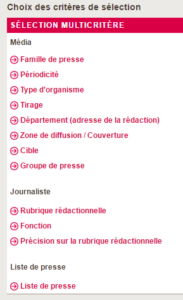
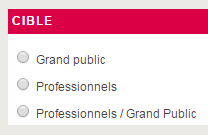
Target: I am aiming for the national press (I could limit myself to a specific region), both trade and general public.
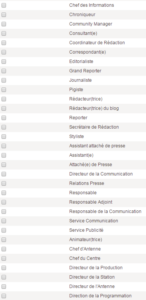
Role: the list of roles is extremely comprehensive, and I do not fully grasp how important this is. At this stage, I am not quite sure how to make my selection, which will cause a problem later: I will need to choose a maximum of 3 people per outlet, and it will take me a long time to sort through. Fortunately, the system performs an initial deduplication (some journalists belong to multiple outlets).
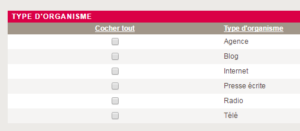
Press category: I make a fairly broad media category selection (which will prove to be too broad):
Done, I insert the press release and press kit into the editor, and move to distribution.
2.5. Distributing everything
I end up with a total of over 1,696 journalists. I need to segment the send into 4 separate batches.
2.6. Tracking your PR campaign
Monitoring the campaign is almost essential: you can follow up with journalists by email, phone or social media, but as explained above, I do not have the time required and decide to stick to email only.
Here are the results obtained:
- Number of journalists who received the email: 1,696.
- Number who read it: 485.
- Number who opened the Press Kit: 123.
- Number of articles obtained: 3 in blogs – 1 in … Femme Actuelle.
The miracle finally happened: I secured an article in one of the most widely-read print magazines in France, with over 3.5 million readers: Femme Actuelle.
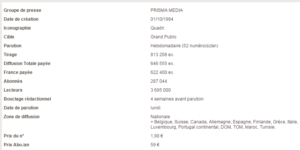
The journalist asks for a few visuals, which I send immediately, and the long wait before publication begins.
Publication and results
In the end, what were the outcomes?
The CatSonics website gained a few additional links from the blog articles, but nothing earth-shattering. I had not managed to attract the bigger bloggers for this first attempt.
The Femme Actuelle article did appear a few weeks later but, unpleasant surprise, none of the visual elements I had provided were used. We ended up with a tiny sidebar item and a few sentences. The impact in terms of visits and sales was minimal.
Lessons learned and conclusion
My first analysis: a one-shot action is not enough, at least not in our case. We will need to find a different angle of attack, prepare other releases, build relationships with journalists, send them goodies (CDs for example), etc.
One of the best ways to get your brand or service offering known is to get the press talking about it.
With hindsight, the solution is not there, however. As a professional in the field (Jean-Luc Saphar) confirmed to me a few months later, newsrooms no longer have the capacity to process the majority of pitches they receive. You therefore need to:
- Make a very strict selection of the people to contact.
- Provide 3 versions of a press release that they can simply copy: short, medium and long. These texts must be very clear, concise and of impeccable quality.
- Attach directly around ten visuals of perfect quality for the publishing world.
- Follow up repeatedly over the weeks that follow, to offer to improve the materials provided and encourage them to publish.
The experience was nonetheless very interesting. I got a taste of an excellent way to get ourselves known, and I fully intend to continue because, after France — which is for me a laboratory where I can do my learning — I need to tackle the UK, Germany and Japan, where our real clients are. DataPresse conveniently offers databases for some of those countries.
I am ready to do it all again. Are you?
Looking to boost your brand’s online visibility beyond press relations? Discover our GEO LLM strategy to appear in AI-generated answers, or learn more about Stéphane Jambu and his approach.
[hc_faq] Q: What are the publication results? A: The CatSonics website gained a few additional links from the blog articles, but nothing earth-shattering. The article in Femme Actuelle appeared but with minimal visual coverage, and the impact in terms of visits and sales was minimal. Q: What are the lessons learned and conclusion? A: A one-shot action is not enough. You need to build journalist relationships, send goodies, provide multiple versions of releases, attach quality visuals, and follow up repeatedly. [/hc_faq]